Miss Tadey’s Favorite Picture
This summer we asked each of the TAP teachers to look back at their photo albums and pick one picture that was their all-time favorite from any of their TAP trips. That was a tough task for some of us, but Miss Tadey managed to find one – that wasn’t just a cool picture, but also a fantastic memory, and an amazing moment during our trip to Japan. I guess those memories to cherish those moments are the reason we all bring cameras on our adventure.

The grounds surrounding Nijo Castle in Kyoto, Japan.
Picture taken June 19, 2012 when we were in the city of Kyoto. Coincidentally, Kyoto was the capital of Japan, “Kyo To” until Tokyo took the title and they flipped the word “To Kyo” Although, I can’t find confirmation of this fact, maybe I made it up.
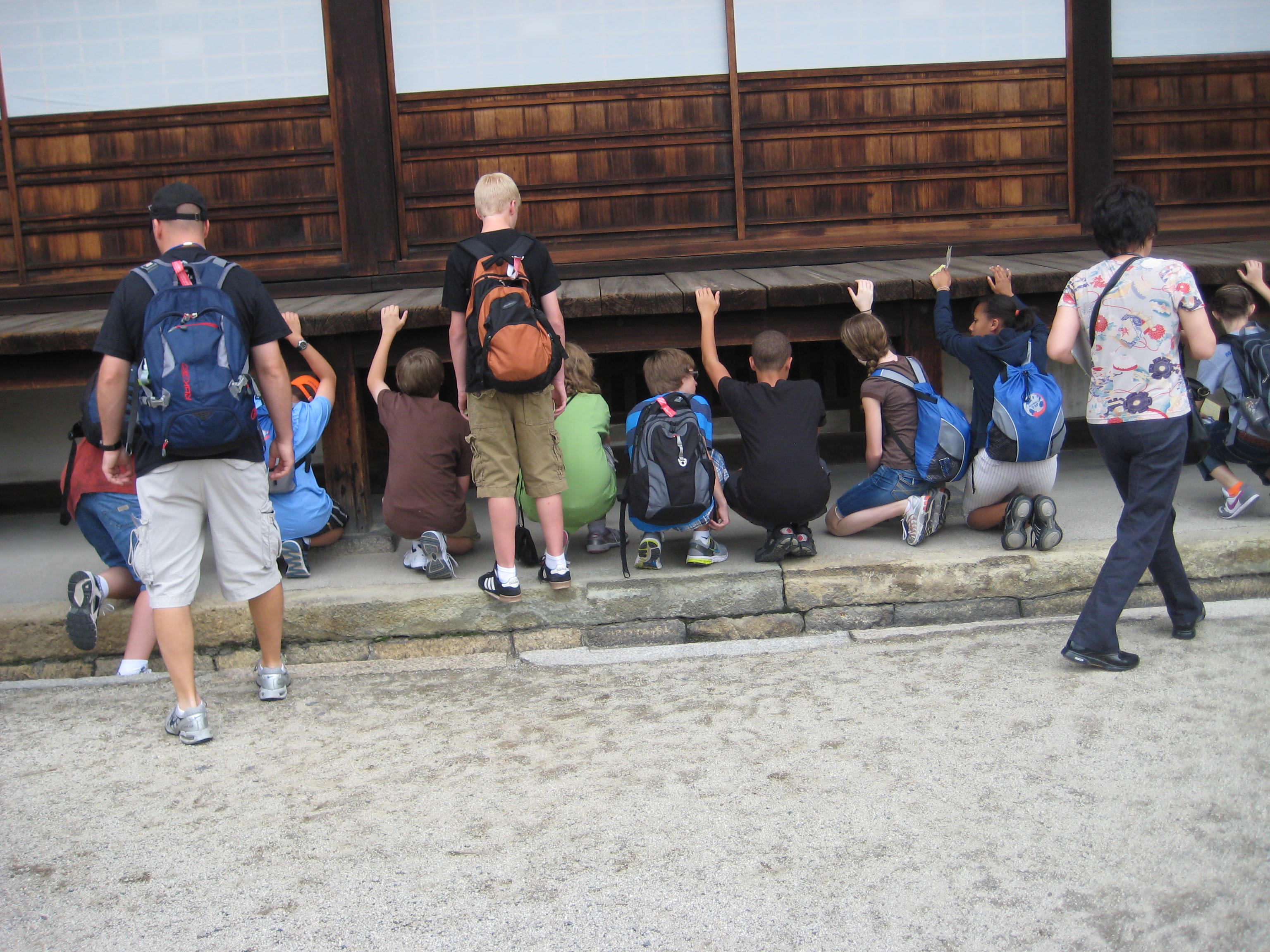
Minooka students peeking underneath Nijo Castle to see how the creaking floorboards work.
Miss Tadey’s Musical Tour of England
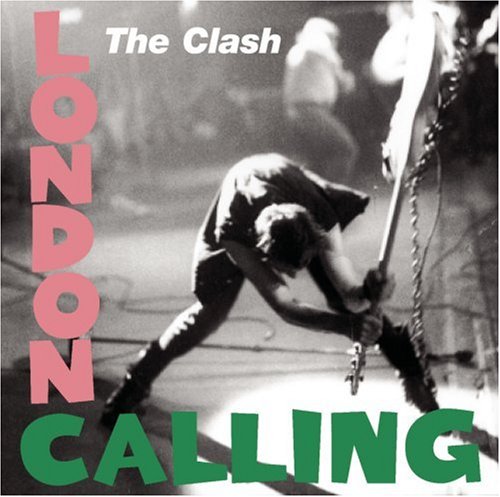
We’re not going to question Miss Tadey’s musical tastes, but this guy isn’t even holding the guitar correctly.
Has anyone checked out the trip countdown lately? The numbers are getting smaller every day and I am getting more excited the closer our trip gets. Just like everyone else is doing, I am going through my packing list to get ready. Toothbrush, walking shoes, adapter/converter, water bottle, etc. By now, everyone should be familiar with the list, but I like to do something else to get ready for upcoming cultural immersions.
I make a playlist.
After all, nothing displays the soul and attitude of a culture that music can. The Brits have a rich musical history to pull from, and I have put together a pretty expansive list of music. I want to share of few of the list highlights with you. Don’t expect to see artists like Adele, One Direction, or Mumford and Sons on this list. They are all great and have excellent perspectives to offer, but I wanted to share with you some groups that you might have forgotten about or maybe are completely new to you. Since you are about to expand your travel horizons, I wanted to give you a head start by expanding your musical horizons.
Keep reading to see Miss Tadey’s English playlist (click on the title so see the YouTube video)…
Madam Tussaud’s: The Good Kind of Creepy

Never in a million years did we think we’d put a picture of One Direction on our website. Technically we still haven’t, because these are just wax statues.
Admit it, there’s a movie star out there that you’d give anything to meet. You’ve probably had daydreams while writing a social studies paper about actually standing next to some of those historical type people in the text book, too. And, we know your deep dark secret – haven’t you wished, way down inside, somewhere in the depths of your guts, right near your gizzard, that you could be in the same room as those One Direction lads?
Well, your dreams might just come true –in a waxy, glassy eyed, could possibly melt if you breathe on them too much sort of way.
Getting ready for our trips, we’ve studied some pretty influential and important people. We know all their vital statistics – birthdate, deathdate, all their major accomplishments, and even their likes and dislikes – did you know Chris Columbus liked pina coladas and taking walks in the rain and Henry VIII had a thing for chicken pot pie? We know some of the silliest details of their lives, yet, the only visual we ever get of these people is some two dimensional portrait that hardly shows us anything more than their big noses, funny haircuts, and ridiculous clothes. What about how tall they are? How fat they are? What it’s like to stand toe to toe with them?
We can see all that.
Henge, Henge, Everywhere a Henge

Stonehenge – A pile of rocks or Fred Flintstone’s Legos?
Everyone knows all about Stonehenge. Well, I take that back – everyone seems to be aware that Stonehenge exists, and that it’s that big circle of enormous rocks stacked up in an inexplicable circle in Southwestern England, but know one seems to know ALL about Stonehenge. The big questions that will likely remain a mystery forever are How? and Why? Of course, there are tons of theories about why it’s there – a big calendar or clock, a place of worship, burial ground, a star gate, a place to hold hands and sing songs about flowers and butterflies and peace, or maybe it’s an alien landing zone.
The big news to me, however, is that Stonehenge is not alone. It’s not the only henge out there. There are bunches and bunches more.

A bunch of cement posts show where the 25 foot timbers would have been when Woodhenge was still around.
Just two miles northeast of it’s much more famous cousin, is Woodhenge. It’s exactly what it sounds like – a wooden version of Stonehenge. All the scientific dating of the site shows that the Woodhenge is probably over 4,000 years old, so, after that much time, there’s no wood left in the henge, but from the air, archaeologists could see that there was a pattern of holes in the ground that looked like something must have been there long, long ago. Soil samples contained the remains of rotted wood, showing that at one point most of the 168 holes contained wood posts that may have weighed up to five tons each. They were situated in an almost identical pattern to that of Stonehenge. Most of the posts were buried over six feet down into the ground and probably stood over 25 feet tall. Read more…
Our England Book is Ready for Purchase
 A few years ago the Minooka TAP teachers noticed that a lot of our student travelers were lugging around those expensive, heavy travel guide books. Most of them also had a composition notebook in their backpacks to journal each day about their adventures. On top of that, we even had a kid who’d printed up Wikipedia articles about every one of the places we were visiting, shoved them in a binder and lugged that thing around the whole trip.
That was when the idea of a student created book was born. So, for the last four years, the TAP students write a book that combines the best ideas of a text book, a travel guide book, and a journal. The best part is that it’s almost entirely written by the students who are traveling with us. There’s a little help from the teachers, because we get so excited that we can’t help but contribute, and this year some of the parents, a few of our past travelers, and even a few younger kids that hope to travel with Minooka TAP in the future got into the game.
Our book becomes an invaluable resource on our trip, as well as one of the coolest souvenirs ever. On top of that, this is a real published book – the students that contributed are going to have a pretty awesome line on their college applications in a few years.
If you’d like to purchase one of our England books, they are available here https://www.createspace.com/4272976

That’s the cheese race. Notice how the cheese is long gone and some of the people are upside down.
Yes, you read that correctly. Cheese rolling. Not eating, not tasting, not making, not even cutting… this article is about Cheese Rolling.
Every year during England’s Spring Bank Holiday (yes, you read “bank” too), the annual Cooper’s Hill Cheese-Rolling and Wake takes place. You wouldn’t think so, but it is a special honor to be selected to roll a cheese at this event. Rollers are mainly part of the local community, near Gloucester in the range of beautiful rolling hills called Cotsowlds. But it’s not just the locals that want to take part in the cheese rolling festivities – people from all over the world take part in this event.
The competition is pretty unusual. It’s all about racing a wheel of cheese down a big hill. There’s falling, there’s stumbling, there’s inadvertant sommersaults, and there’s… well… there’s cheese.
There are a number of races during this event – five downhill races and four uphill races. Each race might have between two and twenty competitors line up and wait for their race. there’s a Maypole at the top of the hill, and that’s where the Master of Ceremonies (or emcee) escorts a guest to the starting line, helps them sit on the dangerous slope with an eight pound Double Gloucester Cheese, then let’s the wheel of cheese go. That’s where the tumbling, bumbling, and stumbling comes in. This isn’t a smooth, easy hill to run down… this is well let’s just say, if you watch a video of it, lots of people bounce… a lot.
When the cheese is released, and competitors try their hardest to stay upright as they dart down the hill, hurling themselves in pursuit of the cheese. The dangerous dash downhill is about 90 meters from start to finish, but most of the competit

There’s the wheel of cheese on the right, and the Master of Ceremonies on the left. Everyone else seems to have fallen down and gone boom.
se race has always found a way to return. It’s such a strong tradition now that even though the official organizers have been unable to schedule the event the last three years, the Cheese Rolling Race has taken place anyway. N
y hand for the race since 1988. She’s the only cheese maker in Gloucester that uses old-fashioned, traditional cheese making methods.
Just like the traditional cheese suppliers, there also has to be a traditional Master of Ceremonies. The emcee is in control of the entire event. Unbelievably, there have only been six different emcees between 1884 and 2013, and the current one is a local dairy farmer.
Of course, no competition is worth it unless there’s a grand prize – and when the competition involves tumbling head over heels down the side of a hill in pursuit of some cheese, the best grand prize, of course, is The Cheese!

He won, but his cheese seems to have gotten a bit dirty.
We’re just trying to share some of the interesting and strange things we learn about the world around us. This article is from Miss Lara, who has been traveling with TAP for five years. She’s our group’s organizer, nursemaid, and mom. She once fell down in Northern Ireland, however, she’s never won the cheese. If you are affiliated with Minooka TAP (student, teacher, parent, family member, or past traveler) and you’d like to submit an article, please email us at Minookatap2@gmail.com
The Bronte Sisters: Literature’s Greatest Trilogy
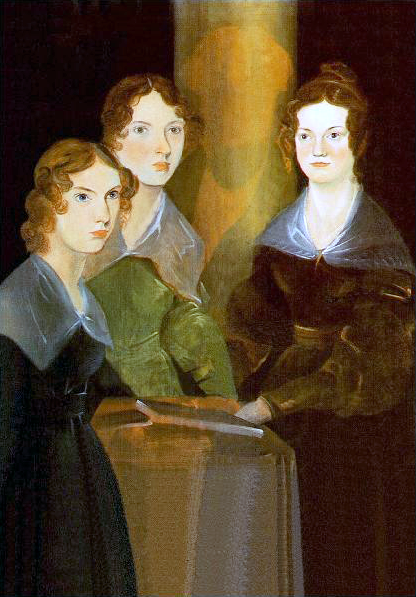
A painting of the Bronte sisters from about 1834. From left to right – Anne, Emily, and Charlotte. The blurry gold blob in the middle was Branwell, who painted this picture, but he later painted himself out of it.
The last few weeks we’ve been posting a series of articles to give our readers more insight into the world around them. This post, about the famous Bronte sisters of Northern England, was written by Mrs. Harig. Anyone associated with TAP – students, travelers, parents, grandparents, former or future travelers – is welcome to submit an article for this space.
In a few months, five TAP teachers, twenty-seven Minooka Junior High students, and a few parents and grand parents are going to spend one night in a hotel in Manchester, England. The next morning we’ll all get up, eat our weird English breakfast – which for some reason has baked beans and a skinless tomato involved in it – and head northeast towards the beautiful city of York.
Manchester is cool, well known for the world’s most famous soccer club, and York, with it’s Viking history and incredible church, is one of the spots I’m looking forward to most – on the way, about halfway through that drive, though, we’ll likely see some road signs pointing us towards a small town called Haworth.
Unfortunately, you can’t see everything on one of these TAP trips. There’s always something that you miss – or as we like to say – there’s always going to be an excuse to travel again. This time it might be Haworth that’s the spot that some TAPpers are going to want to go back to see.
The thing that makes Haworth worth coming back to England to see is that it’s the home to the First Family of Books – the Brontes. Sisters Charlotte, Emily, and Anne Bronte grew up in Haworth in the mid 1800s, writing many of their world famous stories right there in the town.
It’s hard to think of a trio of siblings that were more successful in the literary world, but their lives surely had rocky beginnings and endings. In all, there were six Bronte siblings – five sisters and one brother. Their father, Patrick, was a clergyman assigned to the Haworth parish. There, in 1812, he met and married Maria Branwell.
By 1820, the couple had six kids – Maria, Elizabeth, Charlotte, Patrick Branwell, Emily, and Anne. In 1821, with baby Anne not yet two years old, Maria (their mother) passed away.
The children’s aunt Elizabeth Branwell (Maria’s sister – known as Aunt Branwell) moved in with the family, taking care of the children. Things settled down for a while, with the four older girls all attending the Cowan Bridge School. In the spring of 1825, both Maria and Elizabeth Bronte became ill and were sent home from the school. In May of that year, Maria – just 11 years old – died. Six weeks later, Elizabeth passed away too. She was only 9. Read more…
What the What???

Poland’s Crooked Woods
Continuing our series of posts to help anyone and everyone learn a little bit more about the world around them… Miss Tadey found the weirdest forest in the world – and it just happens to be just a few hundred miles away from where we’re traveling in 2014. Anyone involved in TAP – teachers, parents, students, former travelers, or future travelers are all welcome to submit an article for publication here on our site. Know something weird, cool, interesting, or important – please feel free to share.
Magic forests are usually portrayed as dark, creepy places. There are Big Bad Wolves in there. Candy houses inhabited by child eating witches. Boogiemen. Lions, tigers, and bears. Oh my! However, not every crazy strange forest is filled with baddies – some are filled with wonder, with questions, with… well… the weirdest trees I’ve ever seen.
Pictures of the Crooked Forest of Gryfino have been all over the place on the internet – popping up for the last few years in some Facebook memes, but you probably didn’t realize that the crooked woods were located in Western Poland about two hours east of Berlin, Germany – not terribly far from where TAP traveled on our first trip way back in 2007, and only a few hours from where we’ll be in June of 2014.
The crooked woods are made up of about 400 trees that have a sharp bend in their trunks about a foot off the ground. Each of these trees bends due north and almost all of them for a near perfect ninety-degree angle. Using fancy scientific technology, arbologists (which is an unnecessarily big word that means “tree studier”) have figured out that the trees are about 80 years old and were all bent when they were somewhere between seven and ten years old. In fact, if you look really closely at the pictures, you can see exactly where the trees were bent.
The Life and Love of Jane Austen
In order to give everyone more information about the places we have and will be visiting, TAP is opening up some space on this site for anyone involved in the program (students, parents, former travelers, future travelers, and the teachers) to write some articles about the things that interest them. This article is from Miss Tadey – the MIS Band teacher – who has been with TAP for just over a year now. Miss Tady’s first trip with us was in 2012, when we had an incredible adventure in Japan. She’s now gearing up for her second TAP trip – this year’s adventure in England and Wales.

Jane Austen
Ahhhh, spring. New life. New beginnings. That’s what spring is about for most people, but for me, sometimes spring is about returning to the past instead. Each year around this time I indulge one of my favorite pastimes and reread a book by one of my favorite authors, Jane Austen. This year in the rotation, I will be devouring what could be considered her most popular novel, Pride and Prejudice. It’s an age old story: Girl meets boy, boy falls in love with girl, girl hates boy, drama ensues, girl changes her mind about boy, boy still loves girl, and they live happily ever after. In fact, all six of Austen’s novels have variations on love and have happy endings but that’s not why I love reading them over and over again.
Jane Austen – who lived from 1775-1817 in Central England – does a wonderful job of describing the folly and foolishness of the gentry class in the late 1700s. When you read her novels, you gain an understanding of the idleness of gentlemen and gentlewomen as they go about their daily lives entertaining themselves with gossip, music, philanthropy, hunting, dancing, walking, and ‘taking a turn about the room’. She always includes characters that are utterly ridiculous such as Mr. Collins from Pride and Prejudice, Mrs. Jennings from Sense and Sensibility, or Mrs. Bates from Emma. A novel by Ms. Jane Austen is sure to entertain the reader by laughing at foolishness, engage the reader by providing some sort of scandal, and provide a satisfying, happy ending.
It makes sense that Austen would have an understanding of the gentle class since she was, herself, the daughter of a clergyman. She was the seventh of eight children, and the second of two daughters. With such a large family living on the salary of a clergyman, money was not in abundance but they entertained themselves with the library, running the family farm, and the in-home production of plays. Education was also highly prized for all of the children, so Jane and her sister, Cassandra, were sent off to boarding school. When the girls returned home from school, Jane began writing several plays and short stories. Her family enjoyed her writing and was very supportive, particularly her father, who even tried, unsuccessfully, to have one of her novels published. Read more…
Westminster’s Poet’s Corner
 When I was a little kid, every once in a while I’d do something bad – you know, typical kid’s stuff – fighting with my sister, breaking something, that one day that will forever go down in Curtis History Books as “The Butter Incident”… you know, typical kid’s stuff. Sometimes, when I got into a little bit of trouble, I’d have to sit in the corner and “think about what I’d done.” I hardly ever thought about anything other than what a ridiculous punishment that was.
Regardless, the folks over at Westminster Abbey in London, must not think of corners as a place for punishment – instead, they have a corner of the Abbey that’s a place of honor. They call it “Poet’s Corner,” but it’s not just for poets – authors, actors, playwrights, and even a few dancers and artists have been given the honor of having the Poet’s Corner as their final resting place.
Way back in 1556, Geoffrey Chaucer – the author of the famous story The Canterbury Tales – became the first person given the honor. Now, this probably had more to do with Chaucer’s job as one of the “Clerks of Works” at the Palace of Westminster (that’s the big building with Big Ben attached to it), not so much to do with his writing. However, that was in the year 1400. 156 years later, there wasn’t much left of Ole Geoff except his bones – some guy decided to honor him with a huge, magnificent tomb in the Southern transept of the church. Forty-three years later, another poet, a guy named Edmund Spenser, was given the same treatment and the poet’s corner became a tradition.
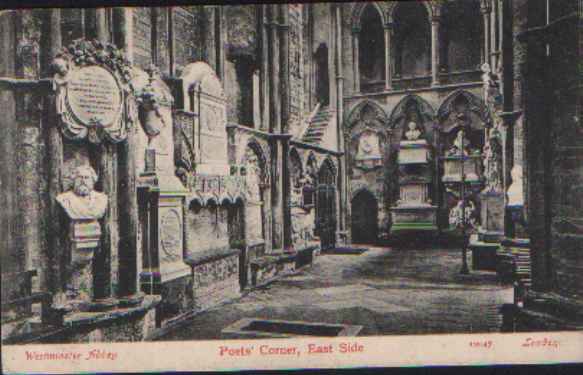 When we stand there in Westminster Abbey, in the Poet’s Corner, we’ll see the final resting places of some incredibly famous names including Robert Browning, Charles Dickens, Rudyard Kipling, and Alfred Tennyson, and memorials to Jane Austen, William Blake, the Bronte sisters, Elizabeth Browning, Lord Byron, Lewis Carroll, William Shakespeare, and Oscar Wilde. If you’re only in 8th grade, not all of those names will mean something to you, but in high school you’ll read works of almost all of them, and two of those guys wrote stories that were turned into Disney movies you’ve likely seen a dozen times.
Still today, people who have made significant contributions to British culture are either interred (not really buried since they aren’t in the ground) or memorialized (meaning their remains aren’t there, but there is a plaque, statue, bust, tablet, or memorial to them) in the Poet’s Corner. The most recent addition will be in November of 2013 when C.S. Lewis, the author of the Narnia books, will be given a memorial 50 years after his death.
I spent a lot of time in that corner “thinking about what I’d done” when I was a kid, but maybe, just maybe, I can turn “The Butter Incident” into a best selling novel someday – then I can end up in the Poet’s Corner when my time here is done. It would be pretty awesome that even though the original Butter Incident ended with me having to paint the kitchen ceiling if the novel version ended with me honored in Westminster Abbey.
Besides Mr. Curtis, author of the best-selling The Butter Incident, is there a poet or author you’re interested in seeing in the Poet’s Corner?


 Minooka TAP